

Ever heard about the term narrative conventions? If you are new as a literature student and are struggling with drafting a good-quality assignment for your submissions, then we are here to help you!
What Are Narrative Conventions?
Narrative Conventions are referred to as the common techniques or elements used in storytelling to create a cohesive and engaging narrative. They aid in shaping the structure and style of a story, making it easier for the readers to understand and follow. Narratives come in a number of types, such as novels, poetry, folk tales, short stories, poetry, etc.
Speaking generally, narrative conventions can be seen in the music and cinema industry.
One must remember that the conventions of narrative do not confuse the readers about the space or time that you are writing about. Usually, the characters in your narrative should be in active voice and oriented towards a goal. The conventions of narrative writing fully rely on written or spoken language along with the visual representation of the character. While drafting your plot, ensure that the character remains an important feature.
Students who are drafting assignments based on the generic conventions of a narrative get a chance to enhance their clarity of elements, imagination, and creativity, along with skills. As engaging an audience is a challenging task, many students face a hurdle in unblocking their creativity and drafting content that is impressive. If you are one of them, then there is nothing to worry about! We are here to help you.
The Two Sides Of A Narrative Convention
Primary Narrative Convention
This side of the narrative convention utilizes a method that helps make a direct effect on the literary content. Let’s quickly discuss the primary narrative conventions list and what all does the method include:
- Setting: This consists of the period setting, destination setting, etc.
- Theme: It includes the core theme, symbol, motifs, etc.
- Conflict: This symbolizes conflict with self, against the society, environment, or another person.
- Descriptive language: Sensory imagery, imagery, figurative language, etc.
- Plot Development: This includes exposition, falling tension, climax, denouncement, and climax.
- Characters: It should have a protagonist and an antagonist
- Characterization: This would consist of thoughts, behavior, dialogues, appearance, interaction, and relationships.
- Point of view: Point of view can be categorized as first person, second person, third person.
Secondary Narrative Convention
Secondary narrative conventions do make an impact but without the use of literary content. Let’s understand how that happens:
- Tone
- Voice
- Character development
- Mood
English Narrative Conventions And Their Types
To create impactful stories, students make use of a number of narrative conventions. Let’s understand the types and get to know these conventions a little better:
- Historical stories
This technique has to do something with the past! If the writer wants to discuss something about a past or include a back story, then this is what they should prefer. Here, the narrator focuses on discussing what happened in the past with some relevant facts that relate to the story. It requires significant historical research and can be utilized in mystery novels, sagas, adventure stories, fantasy, historical romantic fiction, etc.
- Third-person omniscient
As the name suggests, here, the writer will utilize a third-person point of view to narrate the story. Usually, third-person narratives are described as he, she or they. They can also be referred to by their name. It is not imperative that a third-person point of view focuses on revealing information from the past or present. They are used with the intention to relate with the readers directly. For this type of narrative convention, the writer makes use of an external narrator who will know everything about the story.
- Autobiographical novels
A lot of us know what an autobiographical novel means. This type of narrative usually is connected to the personal life of the narrator. The characters include real-life people and stories that they have lived in the past. One should know that a semi-autobiography is different from this one as it does not contain events and incidents that are hundred percent true. This type of writing uses auto-fictional techniques to attract the reader with their content.
- Self-narratives
Self-narratives mostly consist of a character play that is in their own voice. This means that the narrator will refer to themselves as I, but it is not important that he comes out to be the main character of the story. This is one of the most popular examples of narrative conventions used in mystery novels, personal diaries, memoirs, etc. The primary characteristic of this technique is that the narrator discusses what he thinks about himself.
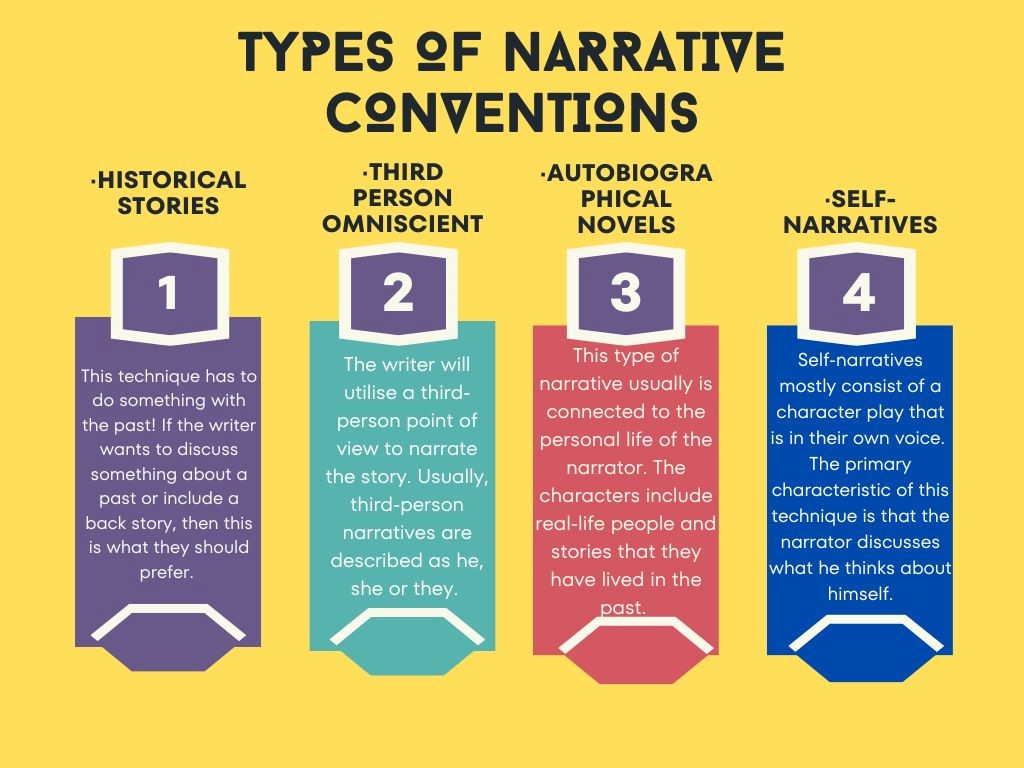
A differentiation table for you to understand the types of narrative conventions
Elements Of Narrative Codes And Conventions
There are several elements when it comes to understanding a narrative convention. Let’s quickly discuss them one by one for a better understanding of the concept.
Fit Into The Character
One of the most important elements of narrative conventions is fitting into the character. This element focuses on developing the character into a real-life person in order to act naturally when playing the fictional character. A clear understanding of the background, important facts, fears, interests, and relationships help the writer help the real-life character fall into line with the script character.
Preparing A Conventional Narrative Structure
It is imperative to know that your story will be built on a structured foundation. Stories are usually plotted to keep the two pillars in mind. The first pillar introduces the main character of the story in order to help the story move forward. In the second pillar, all the essential events take place, and the characters of the story are prepared to follow the motion as it has been drafted.
Preparing A Scene
A scene has multiple elements like dialogue, actions, along with drama that will keep the readers entertained. Scenes are injected into a story to bring life to it. This is exactly how they will start to imagine, feel the character, and relate to the story. These scenes should be special and different from the monotonous story. It could be an action scene or a plot development based on its importance.
Setting
When you feel the play and end up in another dimension to witness the story, it is known as the setting. This element is essential as it helps establish the place, environment, and time where the character performs. Curating an impactful setting of the narrative is very important as it defines that.
The Theme Of The Narrative
This is referred to as the overall concept based on which the narrator drafts the narrative. While drafting your narrative convention assignment, it is imperative for you to have an understanding of the concept, also known as the theme. This will not only help you but the entire team who might work on your write-up to stay on the same page and generate an idea that is valuable.
Conflict
Another thing is the conflict; every narrative convention has a conflict, and the narrator should be clear about how it inspired your story. Doing so will also help the readers to develop empathy with the narrator along with the characters to enjoy what they are reading.
These are just a few basics that are imperative, especially when you are going to draft the conventions of narrative all by yourself.
Examples Of Narrative Conventions
- Personification: This is referred an extraordinary characteristic of a human or an animal
Forge: My horse is a real beauty
- Hyperbole: Here, the writer puts emphasis on a statement in order to express a strong feeling toward it
For e.g., I have a zillion responsibilities on my shoulders.
- Imagery: This refers to explaining a sentence in such a way that the reader can actually visualize the situation
For e.g., It was a bright Sunday morning, and the birds were chirping outside my window.
What To Do If You Are Stuck Drafting A Narrative Convention Assignment?
Students, while pursuing literature, have to run through a number of complicated stuff that can confuse them moving from one concept to another. If you have recently drafted an assignment based on a different concept and want to give yourself a break, then taking external professional assignment help can become the best solution to your problems. Let’s get to know how:
- They have experienced nursing assignment experts that can aid you in falling out of the writer’s block loop.
- You can order your help with assignments by sitting under the warmth of your home, i.e. online!
- Their customer service will help you with your queries and revisions 24/7
- An assignment writer has in-depth knowledge about a particular subject and can provide you with your requirements within the deadline.
These are just a few benefits. Now, the choice is yours, whether you want to do it the hard way or want to take the road that says the smart way! Have a few questions before making an order? Feel free to comment in the section below, and the best nursing assignment help executive will get to you shortly.